O-Level Physics 2026 Paper 2: What Six Years of Past Papers Tell Us
What should students prioritise for the 2026 Singapore-Cambridge O-Level Physics Paper 2? We analysed the 2020 to 2025 papers question by question to identify recurring topics, question types and skills.
With the 2026 O-Level Physics examination approaching, one question inevitably comes up:
What is likely to come out?
Nobody outside the examination setters can know exactly what will appear in the 2026 paper.
Trying to spot topics that are "due", or assuming that something "came out last year, so it will not come out again", can be a dangerous revision strategy.
However, past examination papers can still tell us something useful.
At ChickenTimer Education Hub, we classified questions and subquestions from the 2020 to 2025 O-Level Physics papers. We mapped them against the current syllabus and examined not only which topics appeared, but also what students were actually required to do.
For this article, we are concentrating on Paper 2.
Some patterns are difficult to ignore.
The Clearest Paper 2 Pattern: Be Ready for Circuits
If there is one area I would not want a student walking into Paper 2 unprepared for, it is D.C. circuits.
Complete-circuit problem solving appeared in Paper 2 in all six years from 2020 to 2025 in our classification.
2020: Tested
2021: Tested
2022: Tested
2023: Tested
2024: Tested
2025: Tested
That is 6 out of 6 years.
This does not mean a circuit question is guaranteed in 2026.
It does mean that being unable to handle a complete circuit would be a very risky weakness to carry into the examination.
Students should be comfortable moving between:
Resistance -> effective resistance -> current -> potential difference -> power and energy
Do not treat V = IR as an isolated formula.
A Paper 2 circuit question may require you to connect several electrical concepts within the same structured problem.
Electrical Safety Deserves Attention Too
Fuse and circuit-breaker concepts appeared in five of the six Paper 2 years in our analysis.
These questions can require more than simply recalling what a fuse or circuit breaker does.
Students may have to:
calculate a current
select an appropriate protective device
explain why the device is suitable
apply electrical safety ideas to a practical situation
This illustrates an important Paper 2 pattern:
A calculation may only be the beginning of the question.
Waves: Know More Than v = fλ
The wave equation appeared in five of the six Paper 2 years we studied.
When Paper 1 and Paper 2 are considered together, the wave equation appeared across all six years from 2020 to 2025.
Students should certainly know how to calculate wave speed, frequency and wavelength.
However, Paper 2 preparation should go further.
You should be able to:
Read a wave diagram or graph -> identify the relevant quantities -> calculate -> interpret the result
A student who can substitute numbers into an equation but struggles to interpret an unfamiliar diagram or graph is leaving marks exposed.
Energy Remains One of the Big Topics
Across our 2020 to 2025 classification, Energy accumulated the highest raw classified mark total of any topic.
Important areas include:
kinetic energy
gravitational potential energy
conservation of energy
work
power
efficiency
energy transfers and losses
These concepts may also be combined within a single structured question.
Instead of revising each equation as an isolated item, students should practise problems in which energy changes from one form to another.
You should be prepared to both calculate and explain what is happening.
Forces and Motion: Understand What the Graph Means
Forces and motion are another important area for Paper 2.
Students should be comfortable with:
speed and velocity
acceleration
motion graphs
gradient
area under a graph
resultant force
Newton's laws
air resistance
terminal velocity
A graph question can quickly become an explanation question.
For example, after calculating an acceleration, the next part may ask why the acceleration changes.
That requires Physics reasoning, not simply another formula.
Students should be able to connect:
Force -> resultant force -> acceleration -> change in motion
Light: Calculation, Diagrams and Explanation
Refraction, critical angle and total internal reflection have shown strong recurrence in the papers we analysed.
Students should be prepared to work with:
ray diagrams
refraction
refractive index
critical angle
total internal reflection
optical fibres and other applications
Again, Paper 2 can test several different skills within the same topic.
A question may require a calculation, followed by a ray diagram, followed by an explanation.
Knowing the formula alone may not be enough.
Thermal Physics: Do Not Stop at Q = mc(Δ T)
Specific heat capacity is an important recurring calculation, but Thermal Physics contains much more than one equation.
Students should revise:
specific heat capacity
thermal energy calculations
latent heat
melting and boiling
heating and cooling graphs
particle explanations of thermal processes
A structured Paper 2 question could potentially move from a calculation to a graph and then to a particle-level explanation.
Students should therefore understand what is physically happening during heating and changes of state rather than relying entirely on equations.
Electromagnetic Induction and Transformers
Electromagnetic induction is another recurring area worth serious revision.
Transformer calculations appeared across all six years overall in our current 2020 to 2025 classification, although they did not necessarily appear in Paper 2 every year.
For Paper 2, students should understand the sequence of ideas:
Changing magnetic field -> induced e.m.f. -> transformer operation -> voltage and turns calculations -> electrical transmission
Do not learn the transformer equation in isolation.
Students should also understand why electromagnetic induction occurs and why transformers are useful in electrical power transmission.
Radioactivity: The Chapter Students Should Not Gamble On
Radioactivity needs special treatment because the syllabus changed.
If we simply looked at 2020 to 2025 and said Radioactivity appeared in "two out of six years", we would create a misleading statistic.
The older papers were not equally eligible for comparison.
For the current syllabus period represented in our dataset:
2024: Tested
2025: Tested
That means Radioactivity appeared in:
2 out of 2 eligible years
This does not prove that Radioactivity will appear again in 2026.
Two years is far too small a sample from which to claim a reliable 100 percent future probability.
However, it does challenge one particularly dangerous revision argument:
"Radioactivity came out last year, so I can probably skip it."
The available evidence shows that Radioactivity was tested in consecutive eligible years.
Students preparing for 2026 should therefore be comfortable with areas including:
nuclear structure
isotopes
radioactive decay
radioactive decay equations
alpha radiation
beta radiation
properties of radiation
half-life
interpretation of radioactive data
applications and safety considerations
Radioactivity should be taken seriously in your 2026 revision.
Paper 2 Is Not Just a Calculation Paper
This may be one of the most important lessons from our analysis.
Calculation is certainly important.
But Paper 2 also requires students to demonstrate skills such as:
conceptual understanding
explanation
graph interpretation
data interpretation
application
representation
deduction
This is why our Paper 2 revision message is simple:
CALCULATE. INTERPRET. EXPLAIN.
If you can calculate an answer but cannot explain the Physics behind it, Paper 2 can still cost you marks.
If you understand a chapter but cannot extract information from an unfamiliar graph, table or diagram, the same problem arises.
And if you have memorised model answers but cannot apply an idea in an unfamiliar situation, Paper 2 has many ways to expose that weakness.
What Should You Prioritise for 2026 Physics Paper 2?
Based on the patterns found in the 2020 to 2025 papers, our high-priority practice areas are:
D.C. circuits and electricity
Electrical safety
Waves
Energy
Forces and motion
Light
Thermal Physics
Electromagnetic induction and transformers
Radioactivity
Pressure and other examinable areas
This is not a list of everything that can be examined.
It also does not mean that a topic should be skipped simply because it is not near the top of this list.
Instead, these are areas where the historical evidence gives students particularly good reasons to make sure they are well prepared.
If We Had to Make a 2026 Paper 2 Prediction
Now for the more speculative part.
The following is deliberately a prediction based on past-paper patterns, not a claim about what will actually appear in the 2026 examination.
If I had to construct a possible 2026 Paper 2 based on the patterns we have observed, I would expect to see some combination of the following.
1. A Substantial D.C. Circuit Problem
This would be my strongest individual prediction.
Complete-circuit problem solving appeared in Paper 2 in all six years from 2020 to 2025.
Students should be prepared for a multi-step problem involving some combination of resistance, current, potential difference, effective resistance, power and energy.
2. Energy and Mechanics
A structured question could combine kinetic energy, gravitational potential energy or conservation of energy with an explanation of the physical situation.
3. Waves
A wave calculation accompanied by graph, diagram or data interpretation would be entirely consistent with the patterns we have observed.
4. Forces and Motion
Students should be prepared for questions that require them to explain changing motion using resultant force, acceleration and Newton's laws.
5. Electricity, Electromagnetic Induction or Transformers
These areas have appeared repeatedly.
A structured question could combine conceptual explanation with calculation and practical application.
6. Thermal Physics
Specific heat capacity, latent heat, heating and cooling information, or particle explanations would all be sensible areas to prepare thoroughly.
7. Light
Refraction, critical angle and total internal reflection remain important areas for revision.
8. Radioactivity
Given its appearance in both eligible years, 2024 and 2025, I would absolutely prepare for the possibility of another substantial Radioactivity question.
Again, this does not mean Radioactivity is guaranteed to appear.
It means there is currently no evidence supporting the idea that students can safely ignore it simply because it was examined recently.
Our Strongest Prediction Is Not a Topic
There is one prediction I would make with considerably more confidence than any prediction about a particular chapter:
Students will need to do more than substitute numbers into equations.
Expect to calculate.
Expect to interpret.
Expect to explain.
A strong Paper 2 student should be able to move between all three.
O-Level Physics 2026 Paper 2 Revision Guide
We have also turned the main findings from this analysis into a visual O-Level Physics 2026 Paper 2 revision guide.
The infographic summarises the high-priority topics, recurring question types and key areas students should practise before the examination.
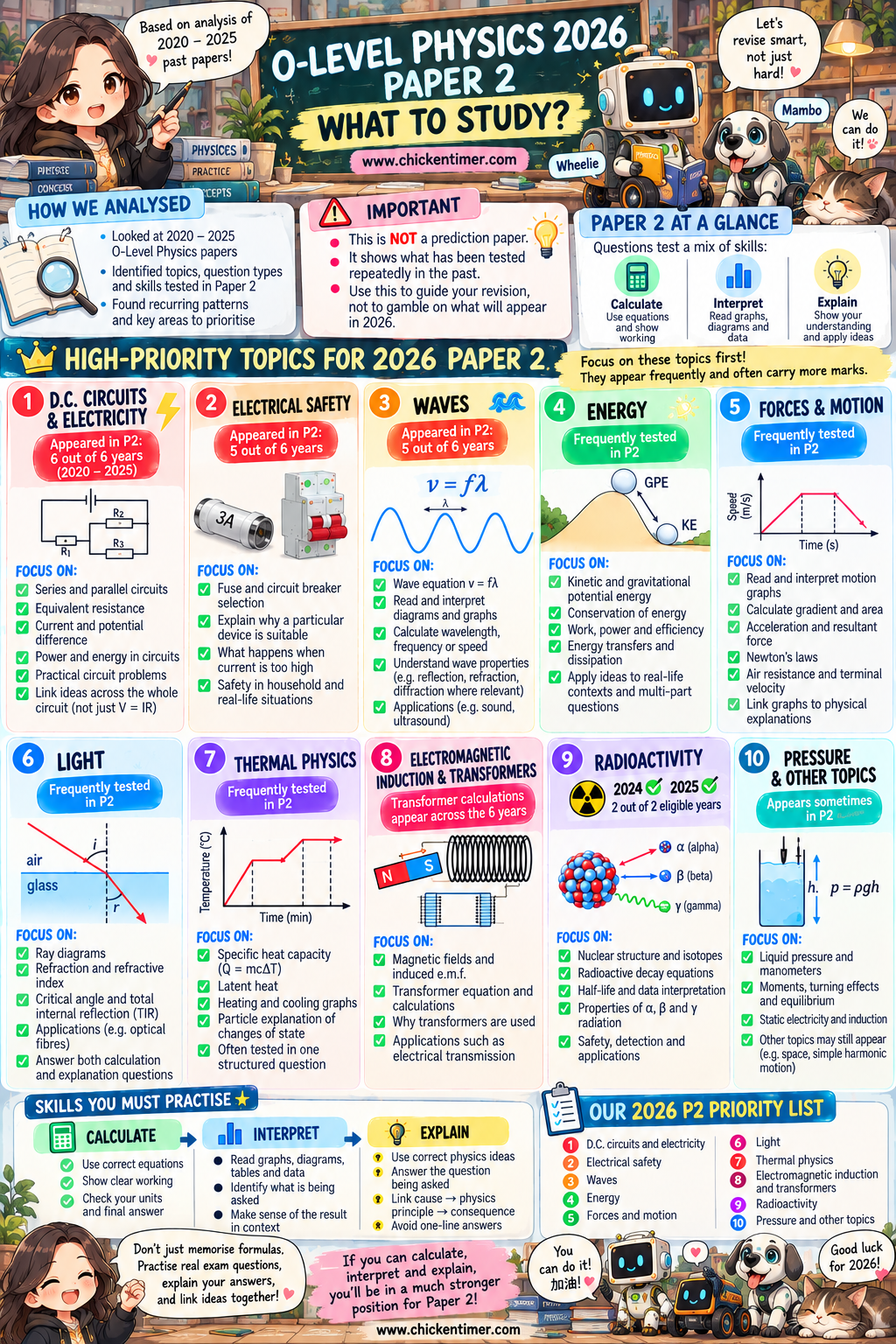
O Level Physics Revision Guide for Paper 2
You can also view our Paper 2 revision slides for a quick summary of the findings.
Final Advice for 2026 O-Level Physics Students
Do not spend the final stage of your revision trying to guess exactly what Cambridge will set.
Instead, ask yourself:
Can I calculate it?
Can I interpret it?
Can I explain it?
Know your equations, but also practise real examination questions.
Learn how to read graphs, diagrams and data.
Practise explaining Physics using precise scientific ideas rather than vague statements.
And do not leave obvious weaknesses in frequently tested areas such as circuits simply because you hope they will not appear again.
The goal is not to predict the paper perfectly.
The goal is to walk into Paper 2 prepared for whatever form the questions take.
